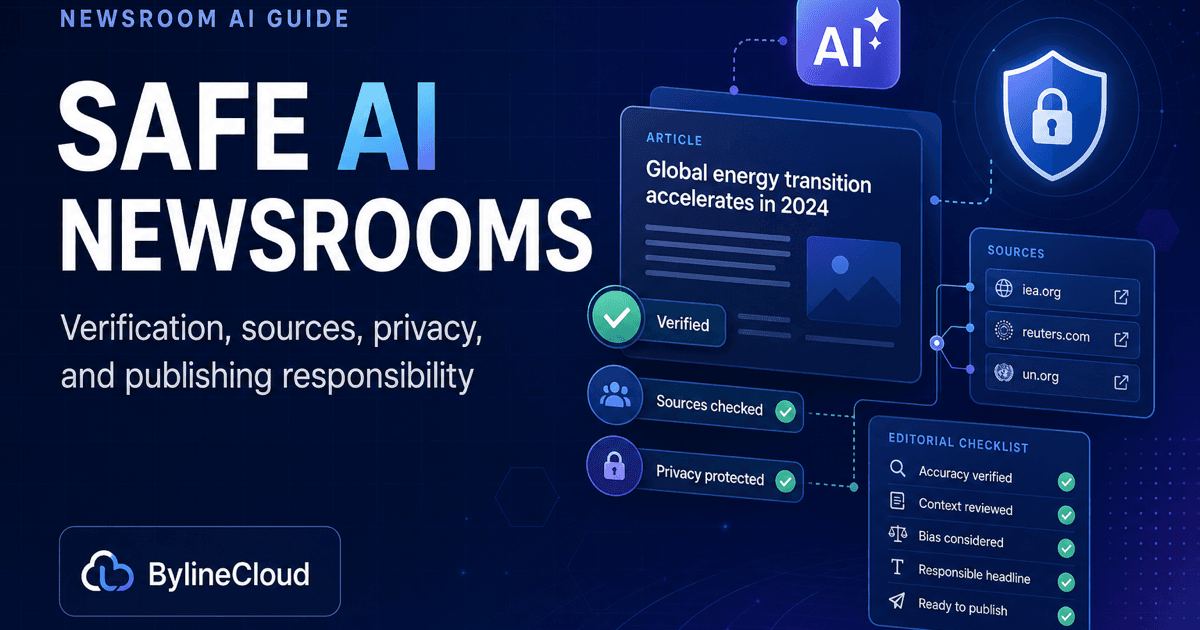
What to decide before using AI as a newsroom assistant
A practical checklist for online newsrooms that want to use AI assistance safely, with clear rules for verification, sourcing, privacy, disclosure, and publishing responsibility.
AI tools can save time in online newsrooms. They are useful for summarizing long materials, suggesting headline options, checking sentence flow, drafting interview questions, and preparing newsletter copy. For small editorial teams, that help can feel especially valuable.
But using AI directly in article production also creates risk. It can invent facts, blur sources, turn sensitive material into external prompts, and make promotional language sound editorial. Readers may not care which tool was used. They care whether the article is trustworthy.
This guide outlines what an online newsroom should decide before using AI as an editorial assistant. The goal is not to replace reporters. The goal is to make AI a limited support tool that works inside clear newsroom standards.
1. Separate what AI can do from what people must do
The first AI decision is not which product to buy. It is what role the tool is allowed to play.
AI can be useful for tasks such as these.
- Summarizing long documents
- Suggesting headline options
- Checking grammar and readability
- Drafting interview question ideas
- Suggesting categories and tags
- Preparing newsletter introductions
- Finding related keywords from past coverage
Some tasks should remain clearly human.
- Deciding the reporting angle
- Verifying facts and checking responses
- Judging conflicts of interest
- Deciding whether something is newsworthy
- Choosing the final headline
- Approving publication
- Handling corrections and reader complaints
An AI-generated draft does not move responsibility away from the newsroom. Readers trust or distrust the publication that published the article. Treat AI as an assistant, not as an author with independent authority.
2. Do not publish facts that have not been checked
AI can connect ideas smoothly even when the source material does not support them. Errors are especially risky with numbers, dates, job titles, organization names, laws, research results, and market rankings.
Before publishing, set simple verification rules.
- Check every AI-generated number against the source
- Compare names and titles with official spelling
- Keep sources for statistics and rankings
- Verify legal or policy explanations against official documents
- Delete claims that cannot be confirmed
A sentence that sounds plausible is not automatically useful. If there is no source behind it, it may increase risk rather than improve the article.
For small newsrooms, a short checklist beside the editing workflow is often enough. A CMS such as BylineCloud can help keep tags, notes, drafts, and pre-publication checks in one place, so different team members can repeat the same standard.
3. Keep sources visible
AI summaries can make sources disappear. Later, it may be unclear whether a sentence came from a press release, a public notice, interview notes, a previous article, or the model itself.
Even when AI is used, the newsroom should keep a visible source trail.
- Save links to original materials used in the article
- State who announced something and when
- Keep notes or transcripts for interview summaries
- Include the institution and date for reports or statistics
- Separate AI-suggested wording from verified source material
Source management protects readers, but it also protects the newsroom. If a correction request arrives, editors need to know why the article said what it said.
4. Do not put private or unpublished material into AI tools
Privacy is one of the easiest risks to miss. A reporter may paste a reader tip, contact list, contract, embargoed release, advertiser document, or unpublished internal note into an external AI service without thinking through the consequences.
Define materials that should not be entered into AI tools.
- Personal data such as phone numbers, emails, and identification numbers
- Source identities and tip details
- Embargoed or unpublished press releases
- Advertiser terms and internal proposals
- Member databases and newsletter subscriber lists
- Legal disputes and sensitive complaints
If AI help is necessary, remove identifying details first. Replace real names with neutral labels and reduce the prompt to the structure of the problem. A simple internal rule can prevent many avoidable mistakes.
5. Let humans choose headlines and summaries
AI can generate attractive headlines quickly. That also means it can produce exaggerated claims, vague certainty, or promotional wording. In online news, headlines affect both search visibility and reader trust, so final selection should stay with an editor.
Review each headline with these questions.
- Is every claim supported by the article
- Has the wording been exaggerated for clicks
- Is it repeating a company or institution's promotional language
- Could readers misunderstand what is confirmed
- Does it include the main search terms naturally
Summaries need the same care. AI summaries may add details that are not in the body or remove important conditions. Compare the headline, summary, and first paragraph before publishing.
6. Decide when AI use should be disclosed
Not every use of AI needs a large notice. A newsroom may treat spelling checks differently from AI-generated paragraphs. Still, the policy should be decided before a confusing case appears.
A simple disclosure standard can work like this.
- No public note is needed for grammar checks or headline brainstorming
- Internal notes should record AI use for summarizing or structuring drafts
- If AI substantially generated body paragraphs, disclose that human editors reviewed the article
- If an image or graphic was AI-generated, note that in the caption or metadata
The main point is not to make AI sound impressive. The point is to avoid misleading readers and to explain what human review took place.
7. Create a pre-publication checklist for AI-assisted articles
AI-assisted articles need a clearer final check than ordinary drafts. Start with a short list of questions that editors can repeat every time.
Use questions such as these.
- Has a human read every AI-generated sentence
- Were numbers, names, dates, and organization names checked
- Are sources saved in the article or internal notes
- Was private or unpublished material kept out of AI tools
- Do the headline and summary stay within the article's facts
- Were advertiser, member, or partner relationships reviewed
- Are AI-generated images, tables, or graphics clearly identified
- Is the final publishing owner clear
The checklist can live in a document, a newsroom note, or the CMS workflow. What matters is that it appears before publication, not after a mistake.
8. Start with low-risk experiments
AI adoption does not need to be all at once. Begin with tasks that are useful but easy to review.
Good starting points include these.
- Five-line summaries of press releases
- Interview question ideas
- Tag and keyword suggestions
- Newsletter subject line options
- Social copy after publication
For the first month, focus less on output volume and more on whether the workflow stayed safe. Track where time was saved, where review took longer, and which AI suggestions created risk. That record will help shape a better policy.
An operating publication such as startuptimes.kr still needs standards before speed. Over time, what matters most is not which tool was used, but which review process protected the article.
AI cannot replace newsroom standards
AI assistance can reduce repetitive work for small editorial teams. Without rules, it can also spread errors, weaken sourcing, expose private information, and encourage exaggerated headlines.
The safe approach is simple. Limit what AI may do, verify facts with human judgment, keep sources visible, and make publishing responsibility clear.
BylineCloud helps online newsrooms manage writing, tags, pre-publication checks, and search readiness in one workflow. Whether or not AI is part of the process, the newsroom's standards remain the real foundation. Before using AI more often, decide how every AI-assisted sentence will be checked before publication.
Start your online newspaper with BylineCloud
We guide you through the entire process, from consultation to launch.
Request Consultation