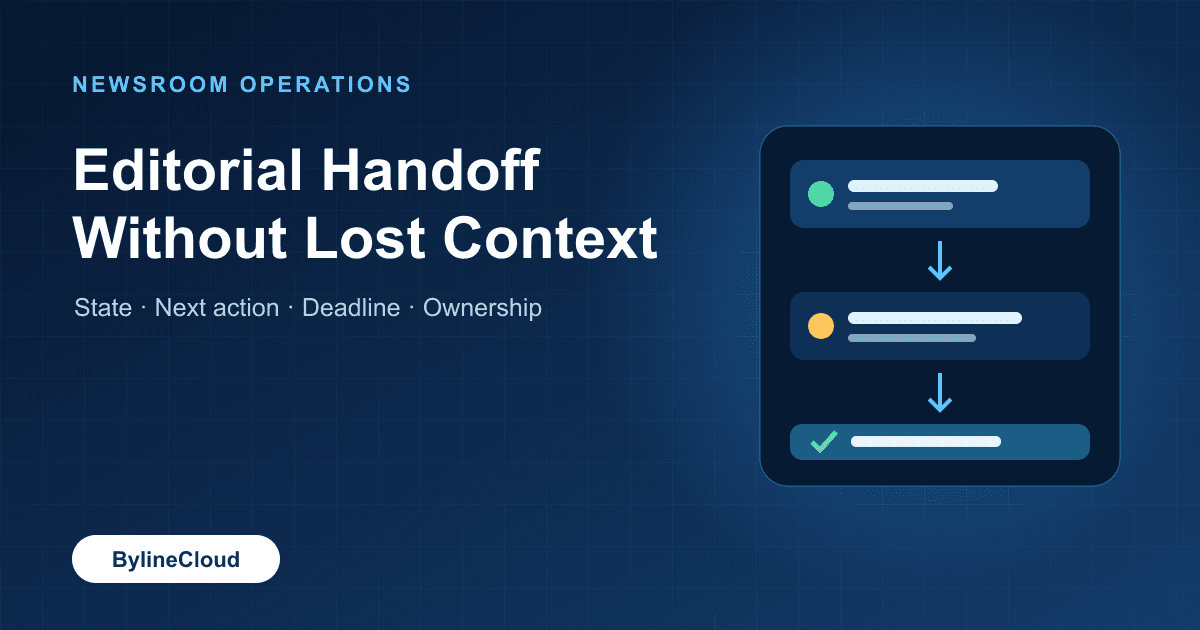
A practical editorial handoff guide for online newsrooms
A practical system for transferring reporting, scheduled publishing, corrections, tips, and operational issues without losing context between newsroom shifts.
In a small online newsroom, one person may report, edit, publish, and respond to readers. When that person signs off, work that exists only in memory can disappear with them. A follow-up call may be missed, a scheduled story may publish twice, or a correction request may sit unanswered. A handoff is not a long activity report. It gives the next responsible person enough context to decide and act.
A useful handoff does not copy every conversation. It records the current state, next action, deadline, risk, and location of supporting material in a consistent format. The following workflow is designed for small teams, including newsrooms without a dedicated overnight desk.
Define when a handoff is required
A shift change is not the only handoff point. Set shared expectations for vacations, field assignments, long interviews, weekends, changes of ownership, and any period when the current reporter cannot respond. A breaking story or sensitive tip may need a backup even during a short absence.
Record “no active items” when there truly are none, so the next person can distinguish an empty shift from a missing update. At the same time, do not transfer every routine task. Include work that requires the next person to monitor, decide, or act.
Make the responsibility transfer explicit. A team might treat the handoff as complete only after the receiving editor acknowledges it, rather than when the outgoing person posts a message. That small rule prevents an unattended gap.
Keep one shared handoff board
When updates are scattered across direct messages, spoken conversations, and private notes, the next editor must reconstruct the newsroom. Choose one official location that the team can reliably access, such as a CMS queue, shared document, or issue board. Use chat notifications to point to the board rather than replacing it.
Show the update time, outgoing owner, incoming owner, and item status. Link to source material and working drafts, but do not paste confidential contacts or sensitive documents into a broad channel. Point to an access-controlled location instead.
Archive completed items with the outcome and completion time instead of silently deleting them. Past handoffs can reveal recurring delays and weak points in the editorial process.
Write each item as a state and a next action
“Story in progress” does not tell the next editor what to do. Write something actionable: “Draft complete; waiting for interview response; if no reply by 3 p.m., ask the desk whether to postpone publication.”
A compact item needs a title, status, owner, next action, deadline, links, and caution note. Use a small shared vocabulary such as reporting, awaiting confirmation, editing, scheduled, and post-publication monitoring. A predictable structure is easier to scan than creative status labels.
When a decision is pending, include the available options and the decision rule. Mark whether it is a routine action or requires editorial approval so the receiver does not have to guess their authority.
Review scheduled content separately
For every scheduled story, record its title, publication time, final approval status, and whether links and cover media were checked. Confirm the time zone and look for conflicts with other coverage of the same event.
If a quotation or number may change before publication, assign a final check instead of relying completely on automation. Record any agreed release condition or embargo precisely and only where authorized staff can see it.
After publication, verify the live URL, mobile rendering, homepage placement, and share preview according to a short newsroom checklist. Scheduling a post is not the same as confirming that readers can access the intended result.
Transfer developing stories as timelines
For fast-moving coverage, a final summary alone can hide why earlier decisions were made. Separate confirmed facts, source claims, unverified reports, and response requests. Put times on important developments and use one consistent chronological order.
Record who was contacted, the substance of the question, and any promised response time. Do not copy confidential conversations into a widely visible board. Link to the protected notes and state what material is cleared for publication.
Include the trigger for the next update: a newly confirmed fact, an official announcement, or a specific time. Clear triggers reduce repeated checking while ensuring that a significant change receives attention.
Track corrections and reader reports
Correction requests, typo reports, takedown inquiries, and replies can lose priority when mixed into ordinary reporting. Keep a distinct section with receipt time, requester, affected URL, request, verification status, and promised response. Escalate questions requiring legal or senior editorial judgment rather than improvising a conclusion.
Even for a simple typo, record what changed and when. A factual change should follow the newsroom's correction policy. “Article updated” and “requester notified” are separate statuses, and both may need to be transferred.
For tips, decide the next action based on urgency, public value, and whether the claim can be verified. Avoid duplicating personal data on the handoff board; link only to the secured original and assigned owner.
Treat system issues as editorial work
CMS login errors, failed image uploads, slow pages, and unreliable analytics affect the next shift's publishing plan. Record when the issue began, its scope, whether it can be reproduced, any temporary response, and who has been contacted. Distinguish whether readers can open articles and whether editors can publish.
If there is a workaround, explain its limits and how to reverse it. An unverified shortcut should not become an inherited habit. When the incident appears resolved, note the pages and actions used to verify recovery.
Never place passwords, authentication codes, or personal account credentials in the handoff. Use the newsroom's approved secret management and access process.
Require a short cross-check
Before signing off, the outgoing editor updates the board and sorts items by urgency. The incoming editor checks for unclear instructions, inaccessible material, and impossible deadlines. An acknowledgment button or brief confirmation is enough if it leaves a clear record.
A short call can help explain a high-risk story, but write the final decision and next action back into the official record. Spoken context is useful; it is not a durable substitute for the handoff.
Once the transfer is accepted, the outgoing person should not remain the default monitor for every alert. The new owner takes responsibility, with specific exceptions agreed in advance. That boundary makes the system sustainable.
Close work that is no longer active
Close completed items with the result and live URL. If reporting ended without a response, state when and why it was closed. An ever-growing list of open items turns the board into an archive that is difficult to use.
Once a week, review old items and reset their owner, deadline, or necessity. When the same omission repeats, improve a checklist, CMS template, or notification rule instead of making every handoff longer.
Set retention and deletion rules as well. Sensitive reporting material should not remain indefinitely by default, while ordinary operating records can follow the newsroom's documentation policy.
Start with a ten-minute routine
Ten minutes before the end of a shift, review active stories, scheduled posts, corrections, tips, and system issues. Give each item a status, next action, deadline, and owner, then sort by urgency. The incoming person confirms access and priority before accepting the transfer.
A complex tool is unnecessary at first. Use one shared template for a week. Add a field when receivers repeatedly ask the same question, and remove fields that nobody uses.
Handoff quality is measured by continuity, not document length. Consistently recording state, next action, deadline, evidence location, and ownership—and confirming receipt—helps a small newsroom prevent a person's absence from becoming a publishing failure.
Start your online newspaper with BylineCloud
We guide you through the entire process, from consultation to launch.
Request Consultation